An idea worth exploring

Many languages.
One more way
to connect.

What if we could share a second language,
while keeping the ones we call our own?

A small experiment in a big human question.
Inspired by The Loom of Language.

An editorial illustration of people gathered around an open book and a shared garden world, connected by conversation.

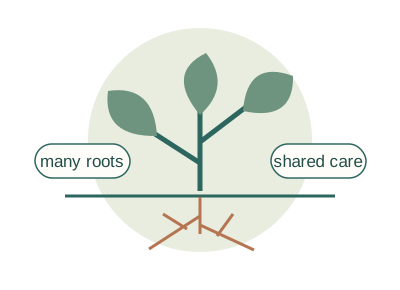
Different roots. A shared possibility.

A work in progress120 proposed words. No learner study yet. Plenty to discover.What we still need to learn

A seven-step introduction

A big idea, in small steps.

Read the full explainer

Move at your own pace. Use the arrows, numbered steps, or your keyboard. Text version of all seven steps.

A little language lab

You can already
build a sentence.

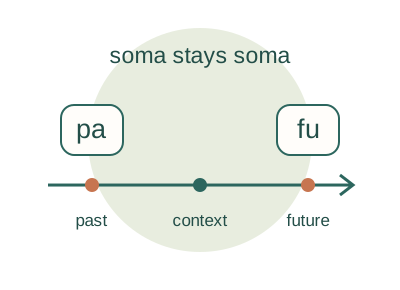
Choose who, choose when, and turn a statement into a question. The word soma stays the same.

Experimental vocabulary · A01

This shows the draft’s rules. It is not evidence that the language is easy for every learner.

01   Who?
02   When?

Your sentence

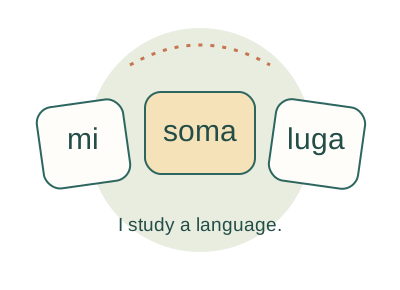
Mi soma luga.

I study a language.

Without a time word, the sentence is general or takes its time from context.

Meet a few of the words

A small beginning.

Tap a word to see its role
and how it entered the draft.

Select a word above to explore its meaning and design notes.

Explore all 120 words and the grammar

Hope, with honest questions

A bridge is worth testing.
It is not a promise of peace.

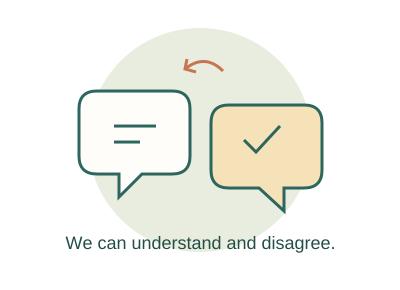
Words can help us share an idea. They cannot settle every difference in beliefs, needs, or power. The aim is to find out whether one more way to talk could help.

Will it be easy for everyone?

We do not know. A familiar sound or word for one person may be new to another. People from many language backgrounds need to test it.

Would it replace my language?

No. The idea is an extra language people could choose to learn. Home and community languages deserve continued care and support.

Why not just use translation tools?

Translation tools and existing languages may meet many needs. A new language must show that it adds something useful. Fair comparisons are part of the proposed research.

Has anyone tested this draft?

No learner study has tested prototype A01. Its 120 basic entries show a starting pattern. The draft does not cover everything people need to say, and many proposed word origins still need checking.

Who gets a say in what happens next?

The project proposes input from learners, speakers, teachers, language experts, and accessibility specialists. A word list with many roots is no substitute for people taking part in decisions.

Follow the thinking

Curious?
Go a little deeper.

The white paper looks at the history, the evidence, and the hard questions. It separates what we hope from what we know.

Where this began

With credit to the people
who asked before us.

This project is inspired by The Loom of Language (1944), written by Frederick Bodmer and edited and arranged by Lancelot Hogben, a substantial collaborator.

Conscious Observer’s proposal explores new choices. It is not a finished language from their book, and attribution does not imply endorsement.

View the paper’s 11 references
  1. 01

    Bodmer, F. (1944; supplied scan lists fifth impression, 1949). The Loom of Language: A Guide to Foreign Languages for the Home Student. Edited and arranged by L. Hogben. George Allen & Unwin. Local primary source: 2015.283471.The-Loom_text.pdf. Printed page numbers are used in citations; printed pp. 481-511 are PDF pp. 495-525. View source

  2. 02

    Genesis 11:1-9. New Revised Standard Version Updated Edition (2021). Passage consulted through Bible Gateway. Used as cultural and theological framing. View source

  3. 03

    Hogben, L. (1943). Interglossa: A Draft of an Auxiliary for a Democratic World Order, Being an Attempt to Apply Semantic Principles to Language Design. Penguin Books. Digitized facsimile hosted by Glosa; first eight PDF pages inspected. View source

  4. 04

    Amano, T., et al. (2023). The manifold costs of being a non-native English speaker in science. PLOS Biology, 21(7), e3002184. Survey of 908 environmental-science researchers; self-reported burdens. View source

  5. 05

    Kenanidis, P., Llompart, M., Fernandez Santos, S., & Dabrowska, E. (2024). Redundancy can hinder adult L2 grammar learning: evidence from case markers of varying salience levels. Frontiers in Psychology, 15, 1368080. Artificial-language experiments; scope is early adult learning. View source

  6. 06

    Dryer, M. S. (2013). Order of Subject, Object and Verb. In M. S. Dryer & M. Haspelmath (eds.), The World Atlas of Language Structures Online, chapter 81. Max Planck Institute for Evolutionary Anthropology. View source

  7. 07

    Fearon, J. D., & Laitin, D. D. (2003). Ethnicity, Insurgency, and Civil War. American Political Science Review, 97(1), 75-90. Publisher abstract consulted; no direct auxiliary-language intervention. View source

  8. 08

    UNESCO (2025). Languages matter: Global guidance on multilingual education. Official publication overview consulted; not the full report. View source

  9. 09

    NLLB Team et al. (2024). Scaling neural machine translation to 200 languages. Nature, 630, 841-846. Technical research milestone; not a 2026 product comparison. View source

  10. 10

    Zamenhof, L. L. Fundamento de Esperanto, English grammar. Online primary text maintained by Akademio de Esperanto. Relevant to the claim audit: regular inflections, compounding, and international vocabulary. View source

  11. 11

    NSW Department of Education and Training (2008). Bilingual Dictionary for ESL Beginners: English/Swahili. ISBN 9780731386451. Selected lexical entries consulted; not an etymological dictionary. View source

Website based on white paper v0.2 and prototype A01 v0.1. Plain-language adaptation and original artwork prepared with AI assistance. No learner results are claimed.